

Hello, this is Attorney Seo Yuri. Today, I'd like to share a case where we achieved victory by utilizing the legal principle of 'joint tortfeasors' in a situation where the adulterous party (the other woman) attempted to evade responsibility by claiming, "The relationship was initiated by the husband, so I am not responsible."
1. Background of the Case 🔍
The client's husband and the defendant were colleagues at the same workplace. The defendant was well aware that the husband was married but continued to engage in extramarital affairs multiple times, eventually leading the client to decide to file a lawsuit seeking compensation from the other woman.
2. The Defendant's Shameless Argument: "The Husband is More Responsible" 🤨
During the trial, the defendant attempted to deny her responsibility by arguing as follows:
-
"This relationship began at the husband's active request."
-
"Therefore, the primary responsibility lies with the husband, so it is unfair to hold me (the defendant) responsible."
3. Attorney Seo Yuri's Legal Response (Joint Tort Logic) ⚖️
I strongly argued that the defendant's claim was legally untenable.
-
Indivisible Joint and Several Liability: The extramarital affair committed jointly by a third party (the other woman) and one spouse (the husband) constitutes a 'joint tort.'
-
Principle of Liability Allocation: Joint tortfeasors are jointly and severally liable for the entire responsibility to the plaintiff, who is the victim.
-
Issue of Right of Indemnity: The fact that the husband may bear greater responsibility is a matter to be considered when the defendant later seeks internal settlement (exercise of the right of indemnity) against the husband. It cannot be used as a basis to reduce the scope of responsibility to the wife, who is the victim.
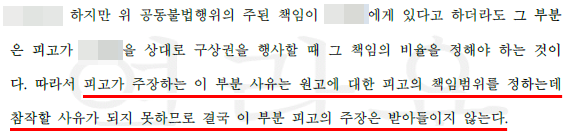
4. Court's Ruling: "Defendant's Claim Dismissed" ✨
The court accepted our argument and ruled as follows:
-
Even if the husband appears to bear greater responsibility, this is a matter between the defendant and the husband.
-
Therefore, the court rejected the defendant's defense, stating that the defendant's liability for compensation to the plaintiff cannot be limited for this reason.
-
In conclusion, the court clearly acknowledged the defendant's tortious act and ordered her to pay the client compensation and default interest.
5. A Word from the Attorney 💬
In adultery lawsuits, the other party often tries to evade responsibility by saying, "I was just tempted" or "The husband is worse." However, legally, extramarital affairs are a joint responsibility. Do not be swayed by the other party's clumsy excuses, and respond with accurate legal principles to ensure that they pay the price for destroying the family.
Are you in a frustrating situation due to the other woman's attempt to evade responsibility? We will resolve the client's grievances to the end with professional legal responses. Contact us for a consultation now. 📩